

← Back to Insights
COMPLETE GUIDE

The Complete Guide to Environmental Product Declarations (EPDs)

Everything you need to know about EPDs—what they are, why they matter, and how to get them for your products.

1

What is an EPD?

An Environmental Product Declaration (EPD) is a standardized document that communicates the environmental impact of a product throughout its lifecycle. Think of it as a nutrition label for sustainability—it tells architects, builders, and specifiers exactly what they're getting in terms of environmental performance.

What an EPD measures

Global Warming Potential (GWP)

Carbon footprint in kg CO₂ equivalent

Water Usage

Total water consumption

Acidification

Contribution to acid rain

Eutrophication

Water pollution potential

Resource Depletion

Use of non-renewable resources

Ozone Depletion

Impact on the ozone layer

Key EPD Standards

ISO 14025 – EPD framework standard
ISO 14040/44 – LCA methodology
EN 15804 – Construction products
ISO 21930 – Buildings & civil works

2

Why EPDs Matter for Building Products

EPDs have rapidly shifted from "nice to have" to "must have" for building product manufacturers. Here's why they're becoming essential for winning business:

98%

of engineers and contractors use EPDs on at least some projects

63%

says most of their clients explicitly ask for EPDs

5

states with Buy Clean legislation (CA, CO, OR, MN, WA)

Who's Requiring EPDs?

Data Centers

AWS, Google, Microsoft, and Meta demand verified environmental data.

Federal & GSA

Government projects increasingly require EPDs.

Healthcare

Major health systems require environmental transparency.

The Bottom Line

Without EPDs, you're increasingly getting filtered out of specs before the conversation even starts. In competitive markets like data centers, healthcare, and government projects, EPDs aren't just differentiators—they're table stakes.

3

The EPD Creation Process

Creating an EPD involves several key steps. Here's what the traditional process looks like:

1

Data Collection

4-8 weeks

Gather manufacturing data, energy usage, raw material inputs, transportation distances, and waste outputs. This is often the most time-consuming step.

Bill of materials
Energy consumption data
Supplier information
Transportation logistics
2

Life Cycle Assessment (LCA)

6-12 weeks

An LCA practitioner models your product's environmental impact across all life cycle stages using specialized software.

Raw material extraction
Manufacturing
Transportation
Use phase
End of life
3

EPD Document Creation

2-4 weeks

The LCA results are formatted into a standardized EPD document following the applicable Product Category Rules (PCR).

Standardized format
PCR compliance
Technical review
4

Third-Party Verification

4-8 weeks

An independent verifier reviews the LCA methodology and EPD document to ensure accuracy and compliance.

Methodology review
Data validation
Compliance check
5

Publication & Registration

2-4 weeks

The verified EPD is published through a program operator and registered in relevant databases.

Program operator submission
Database registration
Public availability

4

Costs and Timeline

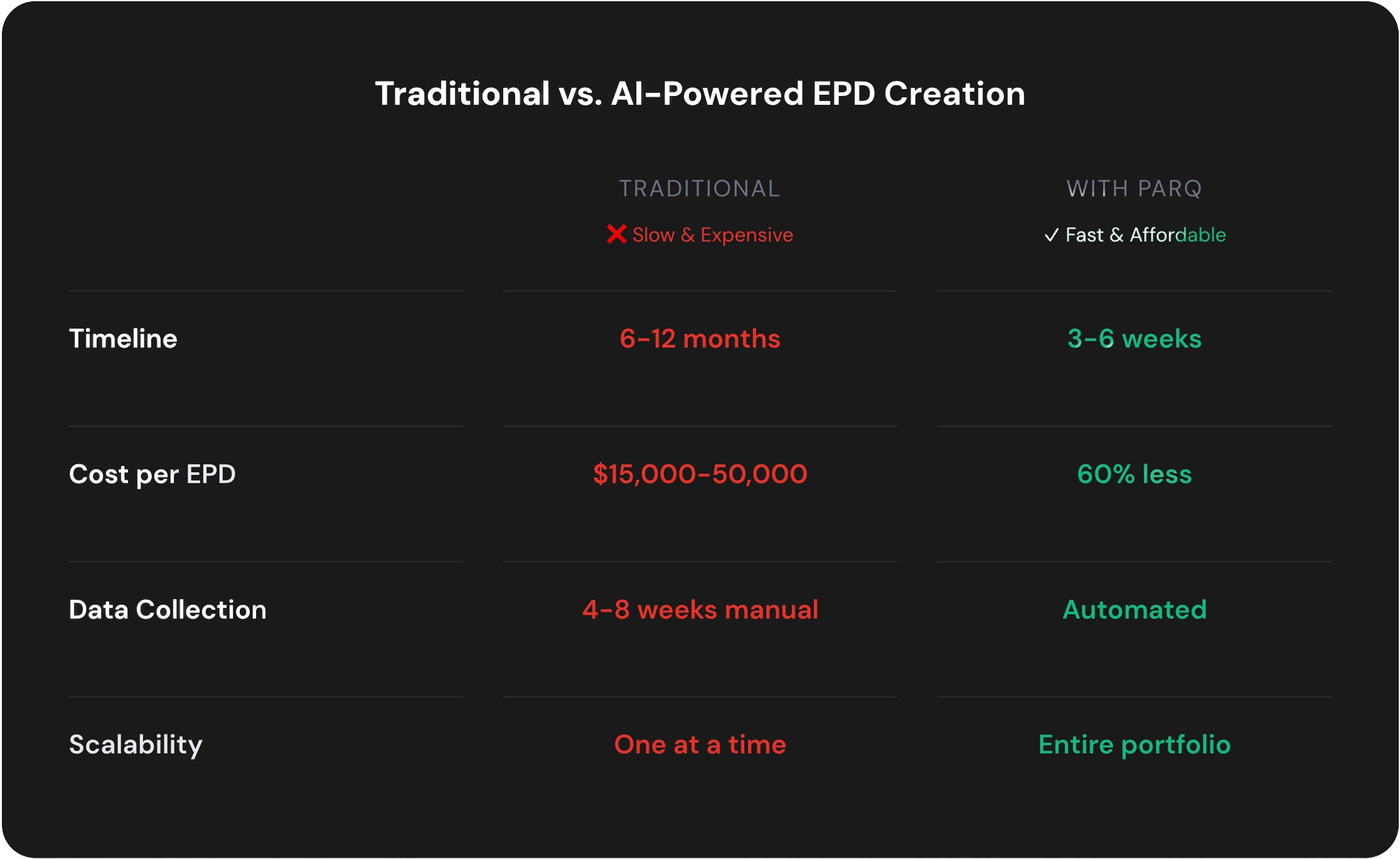
Traditional EPD creation is notoriously expensive and slow. Here's what manufacturers typically face:

Hidden Costs to Consider

Internal staff time

Engineering and sustainability team hours

Opportunity cost

Deals lost while waiting for EPDs

Renewal fees

EPDs expire after 5 years

Multiple products

Each product family needs its own EPD

5

How AI is Changing EPDs

AI and automation are fundamentally transforming how EPDs are created, making them faster, cheaper, and more accessible for manufacturers of all sizes.


Automated Data Collection

AI systems can pull data directly from ERPs, spreadsheets, and supplier systems—eliminating weeks of manual data gathering.

Intelligent LCA Modeling

Machine learning accelerates life cycle assessment by identifying patterns and automating calculations that used to take weeks.

Continuous Updates

AI-powered platforms can automatically update EPDs when manufacturing processes change, keeping certifications current.

Portfolio-Wide Scaling

Generate EPDs for your entire product portfolio simultaneously, rather than one product at a time.

The Result

Faster than traditional

60%

Cost reduction

94%+

Data quality score

6

Getting Started

Ready to get EPDs for your products? Here's how to begin:

01

Assess Your Portfolio

Identify which products need EPDs first—prioritize those required for your biggest opportunities.

02

Gather Your Data

Collect manufacturing data, material specs, and supplier information. We can help automate this.

03

Choose Your Partner

Work with an experienced EPD provider who can deliver verified declarations on your timeline.

Want more insights?

See what leading manufacturers are prioritizing this year.

See the full EPD guide →

Ready to Win More Deals?

Join the manufacturers who are closing faster with AI-powered product intelligence and verified environmental certifications.